Standards
There are currently ten families of DDEX standards that can be implemented to improve efficiency and aid the automated exchange of data along the global digital music value chain. The below map shows how all of DDEX’s standards flow between business partners and integrate with each other. Hover your cursor on the bold black circles and then click on the pop up which will take you to a description of each standard.
You do not have to be a member of DDEX to implement the standards. Anyone can implement the DDEX standards after they acquire a free DDEX Implementation Licence, which is available here.
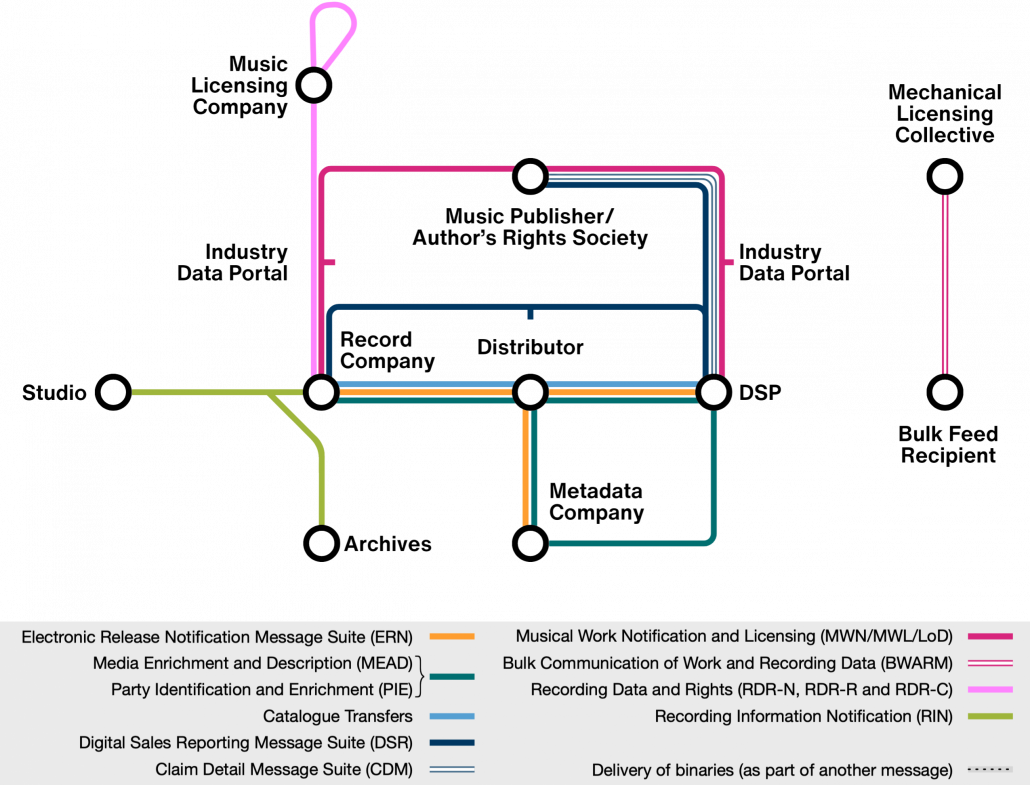
To determine which DDEX standards in the above diagram are relevant to your business, you should read the explanations of each of the standards which can be reached through the links in the diagram. The standards themselves can be downloaded from the knowledge base. The knowledge base also contains more detailed information about the standards and advise about how to approach the implementation of each standard. More general advice about the implementation of DDEX standards is also available on the knowledge base.
Any employee of a DDEX Charter or Full Member can participate in the Working Groups which develop, maintain, and update the DDEX standards, and assist with their implementation. More information on these Working Groups can be found here. There are in all four levels of membership within DDEX, for everyone from individuals to multi-national companies. All the information about membership is available here.
A slide presentation overview about the DDEX standards is available here.
Electronic Release Notification Message Suite (ERN)

The text of the ERN standard with detailed explanations and advice about how to go about an implementation is available on the knowledge base.
The ERN standard messages enable the communication of metadata about releases that are being made available for distribution, and how those releases can be made available. The messages are usually sent by a record company or distributor to a digital music service provider (DSP).
The main message in the ERN standard, the NewReleaseMessage, communicates metadata about releases and metadata about all the resources, usually sound recordings or music videos, contained within a release. Also included in the NewReleaseMessage is detailed metadata about the terms and conditions about when, where and how the releases can be made available by DSPs.
The ERN standard consists of four parts. The first defines the two standard message formats used in an ERN communication. Part 2 defines a series of release “profiles”. These define how the communication of metadata should be constructed for different types of releases in an ERN message. These include, for example, the audio profile or the mixed media profile. Parts 3 and 4 define the choreography for communicating ERN messages using either cloud based storage or web service exchanges.
A slide presentation overview about the ERN standard is available here.
You do not have to be a member of DDEX to implement the standards. Anyone can implement any of them once they have taken out a DDEX Implementation Licence. Information about the Licence is available here and the application form is available here.
Media Enrichment and Description (MEAD)

The text of the MEAD standard with detailed explanations and advice about how to go about an implementation is available on the knowledge base.
The MEAD standard message enables the communication of a broad range of “non-core” metadata about musical works, sound recordings or music videos that can be used for marketing. The message is usually sent by a record company, distributor or other metadata source to a digital music service provider (DSP). This is metadata which would not normally form a part of the data communicated along the supply chain. Such “core” supply chain information is communicated using the ERN standard.
The MEAD standard supports more than 30 different mechanisms for the communication of metadata about releases, resources such as sound recordings or music videos, and musical works in ways that are different from the data exchanged using the ERN standard. It is anticipated that the MEAD standard will frequently be used in parallel with the PIE standard.
A few examples of such metadata includes:
- Metadata about “focus tracks”, which is crucial for voice-activated services. An example of this would be identifying which sound recording or music video is to be played when a consumer asks for, for example, “the latest George-Ezra track”. The “latest” track may well differ from Ezra’s most recently released track because of advertisement campaigns or other events;
- Journalistic material such as reviews about a musical work, a sound recording, an album or a musician;
- Lyrics of musical works or sound recordings;
- Information about artist nicknames, whether “official” or not;
- Information about historic chart positions of and/or awards won by an artist, a musical work, a sound recording or a release; and
- Extended information of interest for aficionados of classical music.
DDEX expects the MEAD standard to develop and expand significantly over the years as greater understanding increases of what sort of information supports the marketing of music by DSPs.
A slide presentation overview about the MEAD standard is available here.
You do not have to be a member of DDEX to implement the standards. Anyone can implement any of them once they have taken out a DDEX Implementation Licence. Information about the Licence is available here and the application form is available here.
Party Identification and Enrichment (PIE)
The text of the PIE standard with detailed explanations and advice about how to go about an implementation is available on the knowledge base.
The PIE standard message enables the communication non-core rich metadata about parties. Parties refers to any individual, such as a composer, a recording artist, a studio engineer or a music publisher, that has contributed in some way to the creation of a musical work, or sound recording or music video. The message is usually sent by a record company, distributor or other metadata source to a digital music service provider (DSR). This is metadata which would not normally form a part of the data communicated along the supply chain. Such “core” supply chain information is communicated using the ERN standard. It is anticipated that the PIE standard will frequently be used in parallel with the MEAD standard.
The PIE standard supports the communication about parties that have contributed to releases, resources such as sound recordings or music videos or musical works. Examples of the type of data about a party that can be communicated using the PIE standard message are:
- Awards won;
- Data about a composer’s or artist’s nicknames or pseudonyms;
- Photographs;
- Biographies;
- Historic charting information; and
- Names of other parties that have influenced a writer or artist.
DDEX expects the PIE standard to develop and expand significantly over the years as greater understanding increases of what sort of information supports the marketing of music by DSPs.
A slide presentation overview about the PIE standard is available here.
You do not have to be a member of DDEX to implement the standards. Anyone can implement any of them once they have taken out a DDEX Implementation Licence. Information about the Licence is available here and the application form is available here.
Catalogue Transfer (CT)

The text of the CT standard with detailed explanations and advice about how to go about an implementation is available on the knowledge base.
The CT standard messages communicate metadata that enables the transfer of catalogues of releases or resources, such as sound recordings or music videos by a reassignment of rights controller information. The messages are sent between a record company and a digital music service provider (DSP).
Catalogue transfers of releases or resources regularly lead to them becoming unavailable to consumers on DSPs’ services, even if only for a short period of time. In addition, consumer-generated data such as playlists or comments are often lost alongside long-term usage information. As a consequence, catalogue transfers, today, involve a considerable amount of administration.
The CT standard is limited to one specific type of catalogue transfer that occurs between just three parties. These are, a relinquishing record company, an acquiring record company and a DSP. The process is sometimes known as “lift and shift”. It enables the DSP to enact a catalogue transfer by reassigning the rights controller information relating to the relevant catalogue from the relinquishing record company to the acquiring record company. This avoids the releases or resources becoming unavailable to consumers or the loss of consumer-generated data. Any subsequent changes of metadata that are needed are managed between the acquiring record company and the DSP using the ERN standard.
This standard in its current iteration does not seek to support catalogue transfers that involve distributors.
A slide presentation overview about the CT standard is available here.
You do not have to be a member of DDEX to implement the standards. Anyone can implement any of them once they have taken out a DDEX Implementation Licence. Information about the Licence is available here and the application form is available here.
Digital Sales Reporting Message Suite (DSR)

The text of the DSR standard with detailed explanations and advice about how to go about an implementation is available on the knowledge base.
The DSR standard messages, which is a flat-file format, enable the communication of metadata about sales and usage generated on a digital music service provider (DSP). The messages are usually sent by the DSP to the relevant rights owner.
The DSR standard has several parts to it. Some of these parts describe elements of the standard that are common to all implementations of the DSR standard. These are:
- Part 1 – Architecture
- Part 8 – Record Type Definitions
Others describe the way in which messages are formatted to convey sales and usage metadata in specific business circumstances. These are known as DSR profiles, so very often, implementers only need to implement the one profile that is relevant to their business circumstances. Most of the profiles have been designed with the reporting of sales and usage in respect of musical works. However, there are two profiles that enable the reporting of sales and usage to the owners or administrators of rights in sound recordings or audio-visual works. The profiles are:
- Part 3 – Basic Audio Profile
- Part 4 – User Generated Content Profile
- Part 5 – Audio-visual Profile
- Part 6 – Royalty Reporting Profile
- Part 7 – Radio Broadcast Profile
- Part 9 – Financial Reporting to Record Companies Profile
- Part 10 – Masterlist Profile
- Part 11 – Basic Audio Profile for The Mechanical Licensing Collective
DSR messages may also be sent or received by companies who are neither digital music retailers or rights owners or administrators but they send or receive such messages on behalf of such organisations.
A slide presentation overview about the DSR standard is available here.
You do not have to be a member of DDEX to implement the standards. Anyone can implement any of them once they have taken out a DDEX Implementation Licence. Information about the Licence is available here and the application form is available here.
Claim Detail Message Suite (CDM)

The text of the CDM standard with detailed explanations and advice about how to go about an implementation is available on the knowledge base.
The CDM standard messages enable the communication of metadata about right claims in musical works and invoice calculations relating to those claims and also enables the identification of any discrepancies identified in that claim information. The messages are usually exchanged between an owner or administrator of rights in musical works and a digital music service provider (DSP).
The CDM standard has several parts to it. Some of these parts describe elements of the standard that are common to all implementations of the CDM standard. These are:
- Part 1 – Architecture
- Part 2 – Record Type Definitions
The other parts specify the message formats. These message formats are known as CDM profiles. These are:
- Part 3 – Basic Claim Detail Message for Musical Works
- Part 4 – Reporting Record Discrepancies
- Part 5 – Reporting Overclaim Discrepancies
Part 3 in turn contains, four profiles that can be used to set out the claim each owner or administrator is making in respect of the musical works identified in the DSR or equivalent message received from the DSP by the owner or administrator. These profile messages also contain all the calculation details behind the individual and aggregate royalty claim being made by each owner or administrator to a level of detail that the DSP can carry out suitable analysis. The Part 4 profile enables a DSP to communicate discrepancies that it has detected, or believes to have detected (other than overclaims) and Part 5 enables a DSP to communicate overclaim discrepancies that it has detected, or believes to have detected.
A slide presentation overview of the CDM standard is available here.
You do not have to be a member of DDEX to implement the standards. Anyone can implement any of them once they have taken out a DDEX Implementation Licence. Information about the Licence is available here and the application form is available here.
Musical Works Data and Rights Communication (MWDR)

The texts of the MWDR standards with detailed explanations and advice about how to go about an implementation is available on the knowledge base.
The three Musical Works Data and Rights communication standards enable companies to exchange metadata:
- About claims of ownership of musical works embedded in sound recordings or music videos;
- Which request and grant licences for using such musical works; and
- Notifying users of such musical works that the ownership of the works has changed, in order that the new owner is paid the relevant royalties going forward
The MWDR standards’ messages are usually exchanged between digital music service providers (DSP), record companies or distributors and musical work rights owners or administrators (including collective rights organisations and music publishers).
The three standards are called, respectively:
- Musical Work Right Share Notification Choreography (MWN);
- Musical Work Licensing Choreography (MWL);
- Letters of Direction Choreography (LoD).
These three standards deal with essentially the same metadata entities as they are inter-related, sharing common structures, ontology and data dictionary. Therefore, the standards contain many similarities with common components throughout.
A slide presentation overview of the MWDR standards is available here.
You do not have to be a member of DDEX to implement the standards. Anyone can implement any of them once they have taken out a DDEX Implementation Licence. Information about the Licence is available here and the application form is available here.
Bulk Communication of Work and Recording Metadata (BWARM)

The texts of the BWARM standard with detailed explanations and advice about how to go about an implementation is available on the knowledge base.
The BWARM standard provides a mechanism for the communication of data about musical works and the sound recordings or music videos that make use of those musical works. In addition, the standard enables the communication of right shares in relation to the musical works set out in the message.
The standard serves a similar purpose to the Musical Work Right Share Notification Choreography (MWN) standard (which is one of the three standards that make up the MWDR standards). MWN is, however, best-suited for the communication of detailed data about a small number of musical works in the context of the licensing of those musical works. The BWARM standard is targeted at communicating, in bulk, data about very large numbers of musical works.
A communication created in accordance with the BWARM standard contains a number of related files. The main file contains data about the musical works and the other files describe entities that are related to those musical works, including for example:
- Alternative titles of the musical works
- Proprietary identifiers of the musical works
- Right share interests in the musical works
- Parties with an interest in the musical works and their roles
- The sound recordings or music videos on which the musical works appear
- Links between those sound recordings and music videos and the relevant musical works
A slide presentation overview of the BWARM standard is available here.
You do not have to be a member of DDEX to implement the standards. Anyone can implement any of them once they have taken out a DDEX Implementation Licence. Information about the Licence is available here and the application form is available here.
Recording Data and Rights (RDR)

The texts of the RDR standards with detailed explanations and advice about how to go about an implementation is available on the knowledge base.
The RDR standards enable the communication of metadata about sound recordings, music videos and performers, and sales and usage data related to the use of the rights in those sound recordings, music videos or performances. The standards’ messages are usually exchanged between record companies, performer representatives and music licensing companies. The collective term, music licensing companies, is applied to collective rights management organisations that represent rights for sound recordings and/or for performers.
The exchange of data between music licensing companies and record companies, performers or their representatives is needed to provide repertoire information to the music licensing companies and for them to send revenue information back to reflect royalties being paid to the record companies and performers. The Recording Data and Rights Notification (RDR-N) standard enables the exchange of metadata about sound recordings, music videos, the identity of the contributors to those sound recordings and music videos and the rights claims in those sound recordings and music videos between record companies, performer representatives and music licensing companies. The Recording Data and Rights Revenue (RDR-R) standard enables the exchange of information about revenues generated from the usage of sound recordings or music videos and the performances they contain. Finally, the Recording Data and Rights Choreography (RDR-C) standard sets out the protocol by which RDR-N or RDR-R messages are exchanged.
A slide presentation overview of the RDR standards is available here.
You do not have to be a member of DDEX to implement the standards. Anyone can implement any of them once they have taken out a DDEX Implementation Licence. Information about the Licence is available here and the application form is available here.
Recording Information Notification (RIN)

The text of the RIN standard with detailed explanations and advice about how to go about an implementation is available on the knowledge base.
The RIN standard enables the communication of metadata about the entities created and the contributors taking part in a “studio session”, which can be anything from music creation software on a computer used in a teenagers bedroom to an internationally famous studio such as Abbey Road. The message is usually sent from a studio to any entity operating in the music value chain, but usually initially a record company. The mechanism for sending the message may vary depending on the circumstances.
Recording information communicated in a RIN message could include contributors with their roles, for example, performers, composers, engineers, or, creations, for example, musical works, or, instrumentation, for example, keyboards, violin, bass drum, or, equipment information, for example, type of microphone, type of mixing desk. The RIN message can travel with the sound files themselves between studios, including any places where music is being recorded, mixed or mastered, as well as to record companies.
Every stage in this cycle can lead to new audio creations, be they a new composition or a new guitar track or a new mix and so on. In each of these “studio events”, there are a number of metadata elements that may be worth capturing. These pieces of data are important for several reasons, including providing attribution (credits) for everyone that participated in the studio event and ensuring that royalties, where due, are allocated to the correct people. Similarly, the richer the data that is eventually provided to retailers, the better they can market the products which can potentially increase the audience and, thus, the revenue generated.
A slide presentation overview of the RIN standard is available here.
You do not have to be a member of DDEX to implement the standards. Anyone can implement any of them once they have taken out a DDEX Implementation Licence. Information about the Licence is available here and the application form is available here.

Membership of DDEX is open to any organisation “with a business interest in digital media content”. Becoming a member of DDEX means you are shaping the digital future. Becoming a member of DDEX ensures organisations can participate in and influence the development of future international standards in the digital music value chain. There are four categories of membership: Charter, Full, Full Individual and Associate.
Organisations do not need to be a DDEX member to implement the standards. Any organisation that has taken out a DDEX Implementation Licence can implement its standard.