
Resources

I am text block. Click edit button to change this text. Lorem ipsum dolor sit amet, consectetur adipiscing elit. Ut elit tellus, luctus nec ullamcorper mattis, pulvinar dapibus leo.

Most DDEX standards are defined using the XML Schema. By validating a created DDEX standard message against the relevant schema, the message sender can ensure it conforms to the syntax of the relevant standard before sending it. Similarly, recipients can ensure a message the recipient has received conforms to the syntax before attempting to ingest it. While syntax validation is not sufficient for a successful message exchange, it is a crucial component.
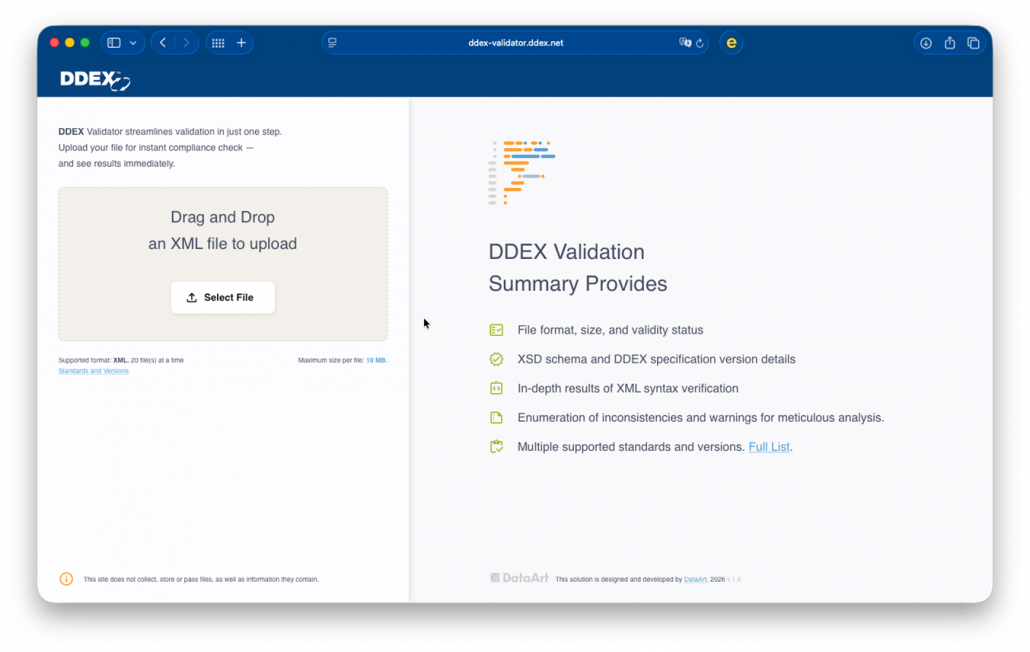
DDEX is now providing an XML validation tool which is available here. The tool can validate up to 20 messages at a time. Many users of the DDEX standards to not have their own validator for the purpose of error checking. So, to ensure a broader adoption and ease of use for our standards, this service is being offered to any sender or receiver of a DDEX formatted message, free of charge.
Once a DDEX formatted message is loaded into the validator it will provide a list of the errors against the relevant XML schema for each uploaded message. An important feature of the validator is that it does not collect, store or pass on any data that has not been uploaded. The DDEX validator currently supports a large range of the DDEX standards and a full list is available here.
The validator was designed and developed by the Media and Entertainment division of DataArt, and DDEX is sincerely grateful to them for their investment in helping expand our offerings to the broader music industry.

Before implementing a DDEX standard companies need to acquire a free standard Implementation Licence.
As part of the process of issuing an Implementation Licence, DDEX will also allocate each applicant a DDEX Party Identifier (“DPID”). It is the DDEX Party Identifier that uniquely identifies each sender and receiver of a DDEX formatted message. DDEX Party Identifiers can also be issued separately from the Implementation Licence for example where a company needs to uniquely identify two departments within the organisation that are sending or receiving DDEX formatted messages. The application form for the Implementation Licence and DPID is at here (please click on the “Apply for a DPID” tab) and the complete terms of the licence are at here.
Also if your organisation is exchanging DDEX formatted messages on behalf of a number of other organisations, where those organisations need to be identified in those messages with a DPID, it may be possible to enter into an agreement with DDEX to be authorised to issue DPIDs on DDEX’s behalf.
If you wish DDEX to consider authorising your organisation to issue DPIDs on DDEX’s behalf, please contact us.

I am text block. Click edit button to change this text. Lorem ipsum dolor sit amet, consectetur adipiscing elit. Ut elit tellus, luctus nec ullamcorper mattis, pulvinar dapibus leo.
I am text block. Click edit button to change this text. Lorem ipsum dolor sit amet, consectetur adipiscing elit. Ut elit tellus, luctus nec ullamcorper mattis, pulvinar dapibus leo.

Membership of DDEX is open to any organisation “with a business interest in digital media content”. Becoming a member of DDEX means you are shaping the digital future. Becoming a member of DDEX ensures organisations can participate in and influence the development of future international standards in the digital music value chain. There are four categories of membership: Charter, Full, Full Individual and Associate.
Organisations do not need to be a DDEX member to implement the standards. Any organisation that has taken out a DDEX Implementation Licence can implement its standard.