About us
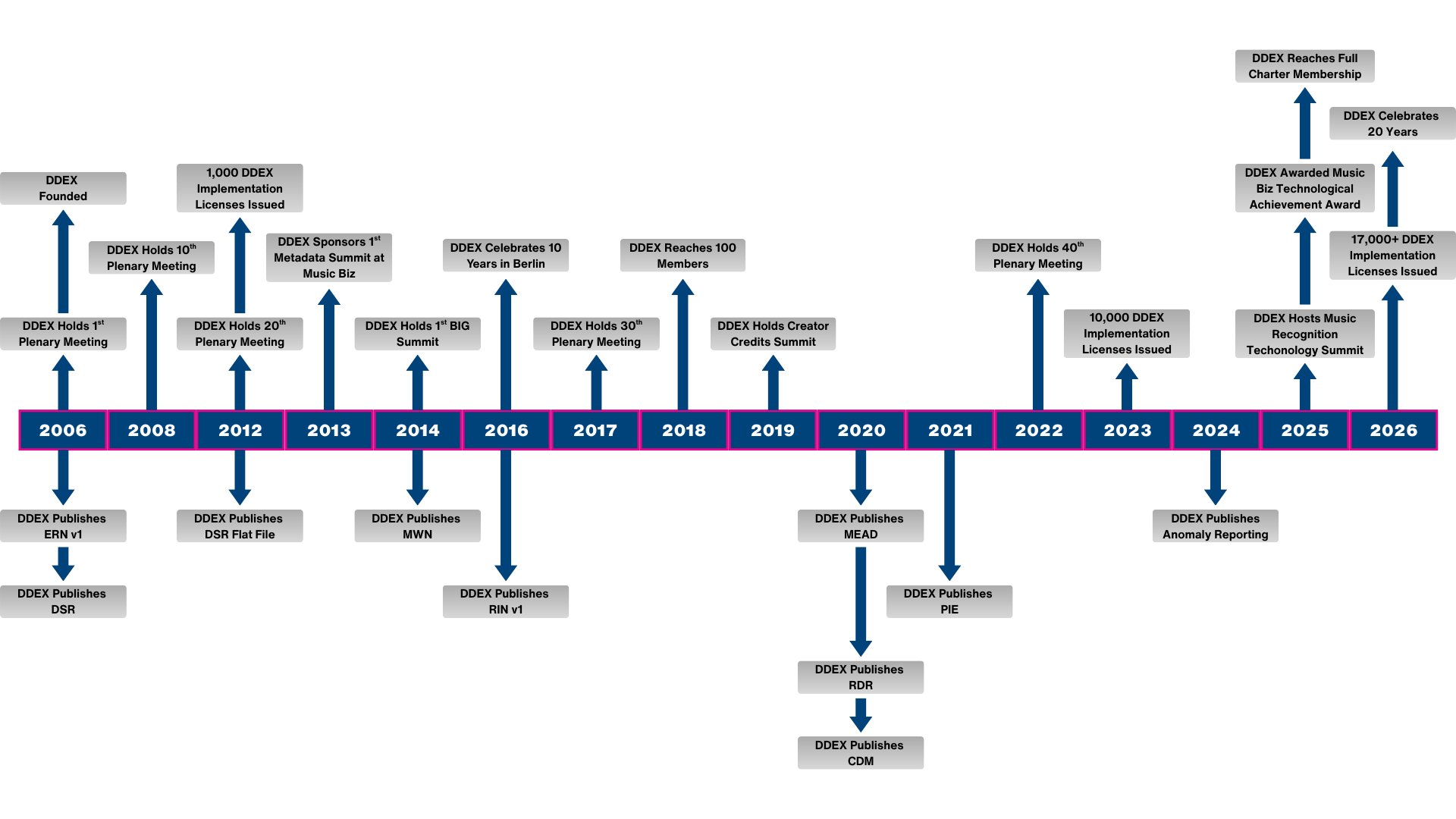
Digital Data Exchange, LLC (DDEX) is a not-for-profit, membership organisation that celebrates its 20th anniversary in 2026
DDEX was established by a consortium of leading media companies, music licensing organisations, rights owners, digital service providers and technical intermediaries to develop standard communication formats to support the exchange of data throughout the digital music value chain. Since set up the membership has grown from right across the digital music ecosystem throughout the world. The number of DDEX members has increased significantly and now stands at over 150 with new companies joining almost every month.
As such, DDEX is the only music industry organisation that has a membership spanning every sector of the industry.
Back in 2006 the founder members of DDEX realised that the legal digital music industry needed to adopt standards related to the way it communicated data about works, tracks, products and all the contributors to their creation (including ownership and sales information). Known as metadata, this needed to be communicated in common formats and then actually exchanged between business partners in the same way so that each party receiving the metadata could understand it.
To support the automated exchange of information along the digital music value chain, DDEX standardises the formats in which information is represented in computer messages and the method by which those messages are exchanged between business partners. These standards are developed and made available for free for industry-wide implementation. Companies do not need to be members of DDEX to implement any of DDEX’s standards.
DDEX standards help all entities in the digital music value chain to more effectively communicate information along that value chain. Using a standardised method of structuring data and a standardised way of delivering that data it cuts out the need to adapt systems for each business partner. With everyone using the same standards, communicating data becomes easier and cheaper, ultimately meaning there is more revenue to be distributed across the whole digital value chain.
As the digital value chain increasingly relies on high volume, low value transactions, only the use of standards can deliver the crucial operating efficiency required. Similarly, as margins are squeezed only an automated global transaction processing infrastructure based on these standards will provide the savings needed to reverse that trend.
DDEX is now the de facto standard for the formatting and delivery of data relating to the digital music value chain and its standards are implemented right across the globe.

As a membership organisation DDEX is governed by the terms of its Operating Agreement. All organisations wishing to become a member of DDEX, agree to comply with and be bound by all the terms and conditions set out in the Operating Agreement. Information about membership is available here.
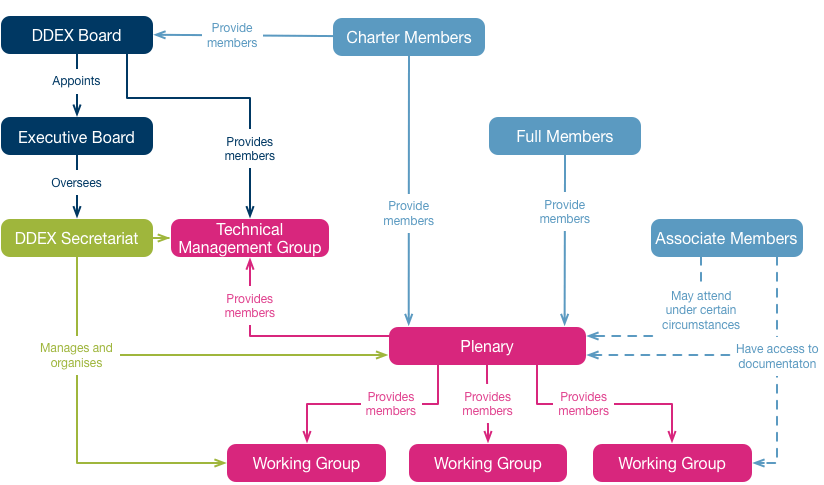
DDEX has four categories of members: Charter Members, Full Members, Full Individual Members and Associate Members.
The Charter Members each provide one representative as a Director for the DDEX Board. The DDEX Board currently has a full complement of twenty-one Directors. The list of Charter Members can be found here. There is a balance of Charter Members on the DDEX Board which is split one third for owners or administrators of musical works, one third for owners or administrators of sound recordings and one third for digital music retailers and technology service providers. Some terms of the Operating Agreement require certain subjects to require a super-majority vote which means it is not then possible for two sectors to out-vote the third. This approach, whilst very occasionally cumbersome, has been the means by which a great deal of trust has been developed within DDEX. The development of this trust right throughout DDEX has been the main reason for its success.
The DDEX Board is responsible for the strategic direction of DDEX. The Board appoints an Executive Board which is responsible for ensuring the Board strategy is implemented. As part of this management process the Executive Board therefore oversees the day-to-day work of the Secretariat.
At the technical standards development level, members of DDEX provide a number of representatives from their companies to attend Plenary Meetings which are the main vehicle used for carrying out DDEX’s technical work. The Plenary Meetings provide technical advice to the Board to assist it in determining DDEX’s strategic goals. On the advice of the Plenary Meetings, the Board appoints a number of Working Groups which usually focus on the development of standards to support particular business processes within the industry.
The final part of the governance of the technical work is the Technical Management Group (TMG). The TMG has responsibility for ensuring that all the Working Groups are taking a common approach to the development of DDEX’s standards to avoid any unnecessary divergence. The TMG also plays an important part in the standards development process by being the body that manages the process of the Disposal of Comments following the declaration of a Committee Draft Standard.


The Board of Directors appoints an Executive Board which consists of two representatives from each of the three sectors represented on the Board itself. The Board also appoints a chair. The appointment of other responsibilities such as treasurer and secretary are allocated by the Executive Board. The Executive Board is responsible for ensuring the day-to-day operations of DDEX are carried out in a way that meets the strategic direction agreed by the Board. The current members of the Executive Board are:

Chair
Dan Simpson – Meta Platforms Inc.
About Dan
Dan Simpson leads the Music Operations team at Meta where his team manages the complex music rights ecosystem that powers musical expression on Instagram and Facebook. He started his career at Sony Music in London in various roles in Music Operations before joining SoundCloud in Berlin to set up their Label Operations function.
Over his 20 year career he has seen the compound value that cooperation and standardisation that DDEX fosters can bring to the music industry.
Dan holds a Master’s degree from UCL and BA from The University of Liverpool.

Chair Emeritus
Kim Beauchamp – Universal Music Group
About Kim
Based in Los Angeles, Kim is SVP Process Innovation & Advanced Operations and oversees the Process Innovation, Advanced Operations, and Metadata Modeling and Standards areas. She focuses on transforming the existing business models and creating new business processes to support the new business models in which UMG is engaging. She designs operational workflows to integrate new business models and complex edge cases in the traditional business models. She also oversees Metadata Modeling & Standards, where she investigates root causes for bad or incomplete data throughout the value chain and oversees the creation of the company’s global metadata standards.
Kim has worked for UMG since 1998, beginning her career within their IT department. She has helped design and develop numerous systems that are critical to the company’s operations, including the digital scheduling system, the asset management and content delivery system, and the company’s global label copy system. She continues to actively work to reimagine the company’s internal tool set and processes to support the ever-changing business.

Nick Williamson – Apple Inc.
About Nick
Nick Williamson is part of the senior leadership team for Apple Music. Having previously been managing director for the online rights agency, Celas, in Europe, and before that the strategic development director at PRS for Music, Nick has extensive experience on the writer and publisher side of the music industry. Since moving over to Apple he has played key roles in the world-wide expansion of the iTunes Store and the cloud locker and re-download service iTunes Match, and the subsequent worldwide launches of Apple Music and Beats1 radio, both of which launched in more than 100 countries at the same time. Nick has served on the Board and Executive Board of DDEX since July 2015 and was its chairman from November 2015 to June 2017.

Kirit Joshi – Sony Music Entertainment
About Kirit
Kirit was involved in the initial set up of DDEX and has guided the organisation in various capacities including: Chairman of the Board for two terms, Chair Emeritus and Executive Board member since the inception of DDEX in 2005. Kirit is also SVP & CIO of Sony Music where he leads the Global Technology Strategy, Operations and Application Security. He has utilised DDEX standards to help transform the digital supply chain to support sophisticated release strategies and the building of a big data environment processing trillions of transactions from commercial and social digital platforms which enable centralised revenue and royalty processing as well as marketing analytics. These capabilities are used to provide Sony Music’s artists and staff with real-time music consumption perspectives and advanced royalty analytics via the Artist Portal. Some of Sony’s DDEX compliance capabilities have also been made available to the DDEX community as open source.
Kirit brings a global perspective to DDEX having lived and worked extensively in Europe, Asia and Africa. Prior to joining the music industry in 1993, Kirit started his career in the finance industry building the first automated stock trading systems using AI, and in the defence industry to build de-centralised secure open system command control systems. He followed an education in Computer Science with a focus on Cognitive Science.
Paul Cohen Scali – Société des Auteurs, Compositeurs et Editeurs de Musique (SACEM)
About Paul
Paul Cohen Scali is Chief Information and Technology Officer at SACEM. In this role, he is pursuing digital transformation in the service of the company’s objectives and its commitment to generate value for authors, composers and publishers. In particular, he is striving to improve member services and strengthen the ability to process ever-increasing volumes of data. It is through these many projects that SACEM anticipates and responds to digital challenges and those of the music sector.
Paul’s started his career in various positions in the military sector and then in new technologies, notably at Cap Gemini. In 1997, he joined Bouygues Télécom, a French mobile carrier, where he contributed to urbanising the information system and worked on mobile phone services as well as on the commercial information system. In early 2009, he joined PMU, a French gambling company, as CTO to implement digital transformation in a context of opening towards competition of the online gaming market.

Nicholas Lehman – American Society of Composers, Authors and Publishers (ASCAP)
About Nicholas
Nicholas Lehman is ASCAP’s Executive Vice President and Chief Strategy & Digital Officer, reporting directly to the society’s CEO, Elizabeth Matthews. Lehman oversees Strategy, Business Development, Product Development and Administration Services as ASCAP enhances services to its songwriter, composer and music publisher members as well as to its music licensing partners.
Prior to ASCAP, Nicholas Lehman worked as Chief Strategy Officer for TEGNA, where he was responsible for guiding the media company’s vision, cultivating strategic partnerships, incubating new businesses, and driving innovation initiatives throughout all areas of the company. Lehman also worked as President of Digital for NBCUniversal, where he oversaw and transformed a portfolio of the company’s native digital businesses, including Fandango, and launched a series of new convergent media brands for NBCUniversal. He also held several executive roles at MTV Networks, where he oversaw digital strategy and operations and launched multiple new businesses in the digital music, mobile, gaming, and social media spaces.
Lehman has an MBA from The Wharton School at the University of Pennsylvania and an honors undergraduate degree from Brown University.

The Board appoints the Secretariat which is responsible for ensuring that the technical work required is carried out in as efficient and a speedy manner as possible and that it meets the requirements of the membership. The Secretariat also manages the promotion of DDEX, member and liaison relationships and recruitment, accounts and DDEX’s operational infrastructure. The Secretariat works on a day-to-day basis with the Executive Board to ensure the strategic goals set by the Board are met.

Mark Isherwood
About Mark
Mark Isherwood spent 18 years working for the MCPS-PRS Alliance (now PRS for Music), the UK music rights collecting society and one of the biggest in the world, in senior management positions. He was responsible for the development of strategies and policies for substantial rights negotiations with a range of licensee industries, including all the major UK television and radio broadcasters and the video industry. Mark has undertaken rights acquisition negotiations for a major pan-European broadcaster, led a team of consultants in a project for the Joint Information Systems Committee (JISC) examining the intellectual property rights (IPR) consequences of using Creative Commons licences in the HE and FE sectors and led a multi-party project for the European Commission assessing the value of the public domain in the digital ecosystem. He was the non-voting Chair of the Global Repertoire Database Working Group from 2010. Mark was involved in the early industry discussions on the creation and development of DDEX and has led the secretariat since DDEX’s incorporation in 2006.

Niels Rump
About Niels
Niels Rump has been co-ordinating the technical standards development at DDEX since 2006. As such, he is the main author of most of the DDEX standards. Niels has worked on the communication of digital rights metadata for more than two decades, initially focusing on developing commercial Digital Rights Management (DRM) systems for which several German and international patents bear his name. During his time at Fraunhofer IIS (the “home of MP3”), Niels started working in DRM-related standards bodies including ISO/MPEG, AES, OPIMA, SDMI and others. For his work on MPEG standards he has received “ISO/IEC certificates of appreciation”. Niels holds a Diploma (approximately equivalent to a master’s degree) in computer science from the University of Erlangen-Nürnberg.

Steffen Lindek
About Stefen
Steffen Lindek has been involved in the technical development and maintenance of the DDEX standards since 2006. His main task is managing the ontology from which the XML message schemas and the data dictionary are generated. Steffen has worked on metadata-related projects for about two decades, mostly with a focus on rights metadata in the media sector. Recently he was involved in two EU-funded projects where he worked on mapping and transforming metadata. Steffen holds a diploma and a PhD in physics, both awarded by the University of Heidelberg, and spent several years in the microscopy group of a research institute for molecular biology.

Vanessa Bastian
About Vanessa
Vanessa Bastian has worked within the music industry for almost 20 years both within major record companies, and across academic research and journalism.
After working at EMI and representing its interests on the IFPI Market Research Committee, she then represented Warner Music International on the GRid (Global Release Identifier) and MI3P (Music Industry Integrated Identifier Project) projects before getting involved in DDEX. Vanessa represented Warner’s interest at DDEX Board level and when moving to Universal Music International as Director of Digital Operations, Vanessa continued to do so for both UMGI and UMG US.
In 2010 she stepped in to assist the DDEX Secretariat to run the 14th Plenary Meeting in New York and is now delighted to be permanently part of the Secretariat.

Jenny Pretz
About Jenny
Jenny Pretz has extensive experience designing and implementing business processes, user interfaces and dataflows that result in fuller and more accurate metadata in the music industry. At DDEX, she focuses is on party metadata and identification.

Ngozi Okorie
About Ngozi
Ngozi Okorie has provided administrative support at DDEX since 2012, although more closely since the beginning of 2018. Her tasks include responding to queries and requests, invoicing, document management and providing project support. Ngozi has worked within the area of office management for several years, prior to DDEX within the market research field.